 Case Study - Regulated Vertical SaaS
Harvestdate
I co-founded a B2B cannabis CRM and supply-chain platform that helped Washington operators manage inventory, product marketing, and direct sales workflows in a compliance-heavy market that had no established playbook yet.

Reconstructed from surviving Express/EJS, React/Redux, and iOS source. Modernized reference mockups, not historical production screenshots.
Washington legalized cannabis. Nobody had built the back office yet.
In Washington's early recreational cannabis market, processors tracked lots and rooms inside state traceability systems like BioTrack, built for regulators, not commerce. There was no established vendor or pattern yet for turning that compliance data into something a sales team, or a buyer, could actually use.
I found that gap early and built the company around it.
Compliance data and sellable inventory were not the same thing.
Lots and rooms lived inside BioTrack. Buyers needed current product information: photos, package sizes, quantities, lab results, and availability. Processors needed a fast, low-friction way to keep that public-facing information accurate as inventory moved through drying, packaging, and the vault.
The hard part was never "build a cannabis marketplace." It was building the translation layer between a compliance system and a sales workflow, without handing the operator a second job.
An operator workflow, not just a catalog
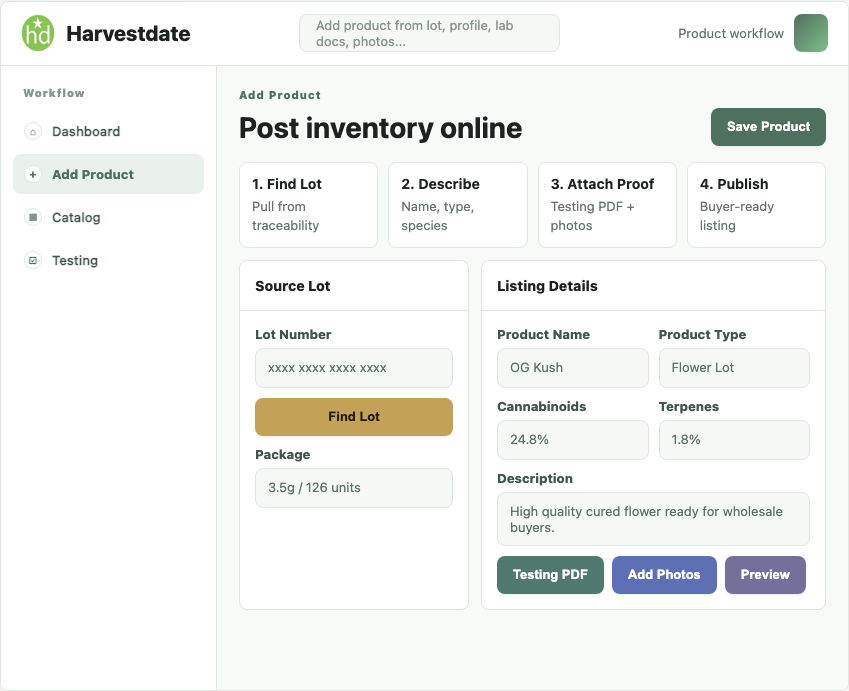
Harvestdate became the layer between BioTrack and the buyer. Operators pulled or entered a traceability lot, added commercial details, attached lab testing proof, added photos, and published it straight into live, buyer-facing inventory.
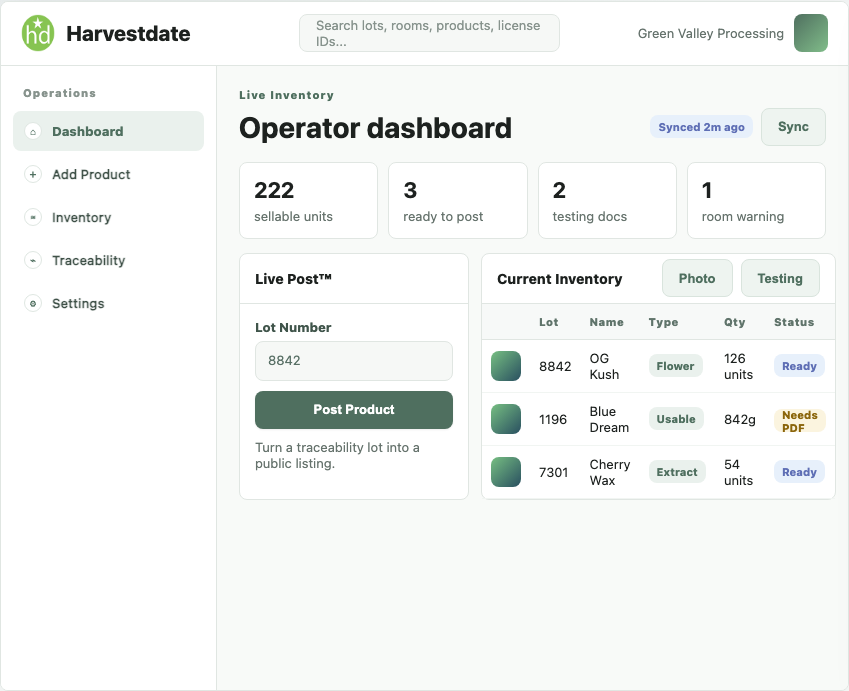
The core loop: live inventory synced from traceability, with a one-field Live Post to turn a lot into a public listing.
1. Find Lot
Pull the lot straight from the traceability system, no re-typing lot numbers.
2. Describe
Add product name, type, species, and a buyer-facing description.
3. Attach Proof
Attach a testing PDF and product photos so buyers can trust what they see.
4. Publish
Push it live as a buyer-ready listing, still tied back to the source lot.
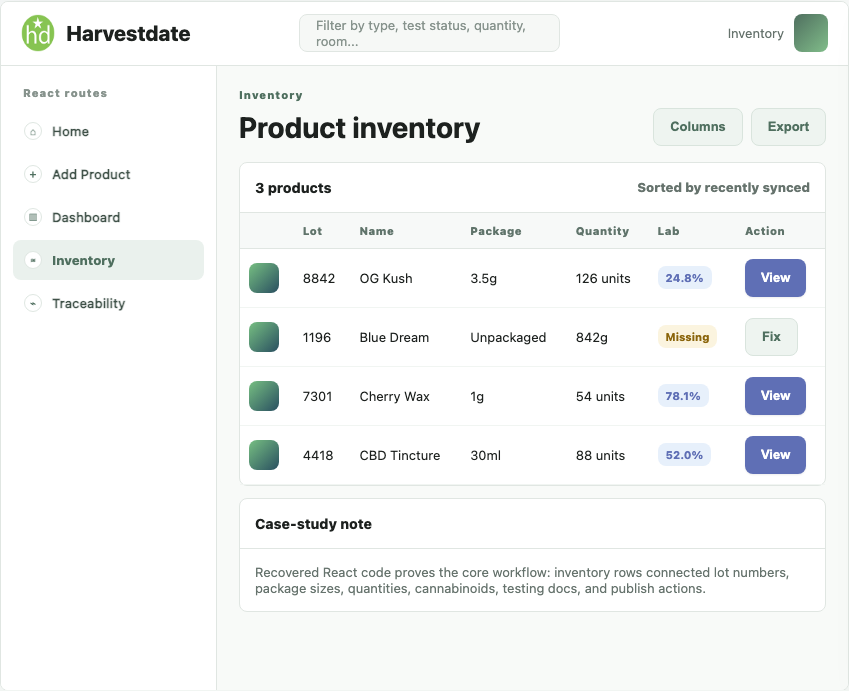
Every listing carried its lot number, package size, quantity, and cannabinoid data back to source, so nothing published was disconnected from the compliance record.
BioTrack closed the loop back to compliance
The Traceability Center connected an operator's BioTrack account, let them watch specific rooms (dry room, packaging, vault), and synced bulk inventory automatically. That sync kept the buyer-facing side honest: anything shown as sellable had to trace back to a real, compliant lot.
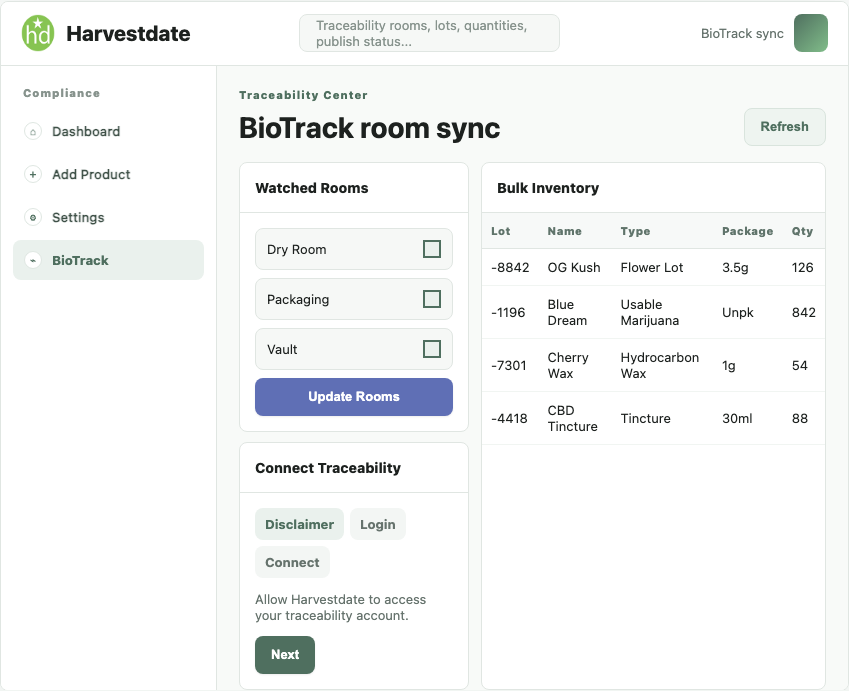
Watched rooms and bulk inventory synced directly from BioTrack, Washington's state traceability system.
Technical Co-Founder, end to end
I worked across product, engineering, and go-to-market from the first line of code through the acquisition.
Market & Product
Found the opportunity and turned BioTrack's compliance data model into something operators could sell against.
Engineering
Built across an Express/EJS web app, a React/Redux rewrite, a Node API, and iOS/Android clients.
Go-to-Market
Sold and onboarded processors directly, growing to roughly 30% of Washington's licensed processors.
~30% of Washington processors. Acquired in 2019.
Harvestdate reached meaningful penetration in a market that had no established vendor a few years earlier, and was acquired in 2019.
The deeper lesson: in a regulated vertical, the product isn't the UI. It's the translation layer between compliance, inventory, and trust. Get that layer right and adoption follows, because you removed real work instead of just making the screens look nicer.
Named to Marijuana Venture Magazine's Top 40 Under 40 Entrepreneurs, 2017.
What this demonstrates
Zero-to-one, new category
Found and shaped a regulated market before there was a vendor playbook to copy.
Full-stack ownership
Express/EJS, React/Redux, a Node API, and iOS/Android clients, plus a live third-party integration.
Compliance-to-commerce
Turned a traceability system built for regulators into a workflow operators actually adopted.
Real adoption
~30% of Washington processors and an acquisition, not just working software.